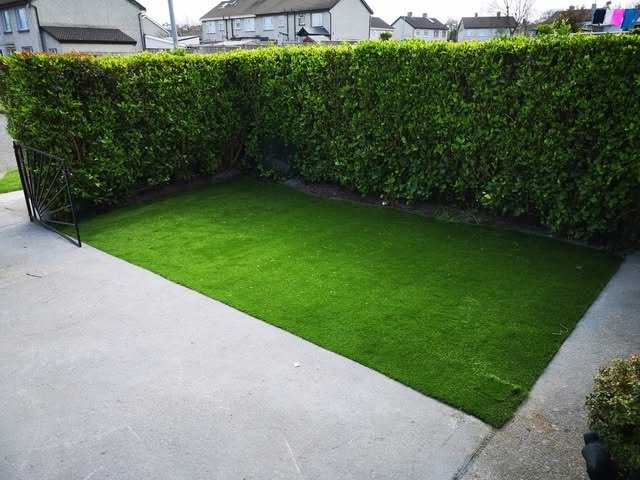
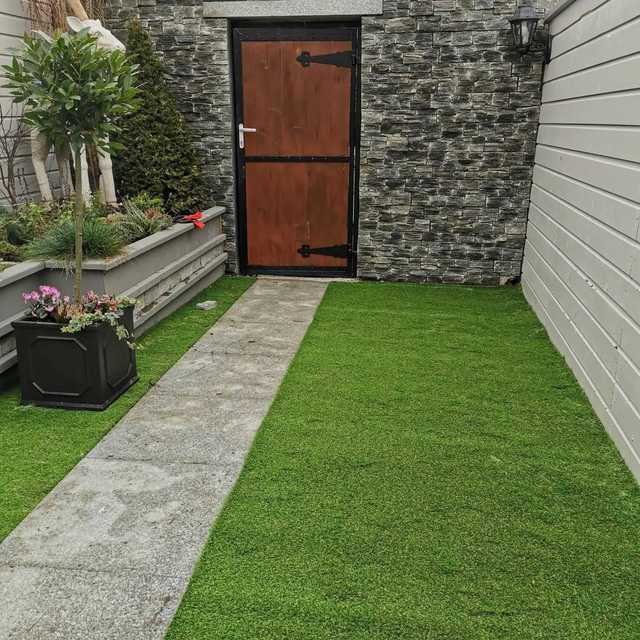
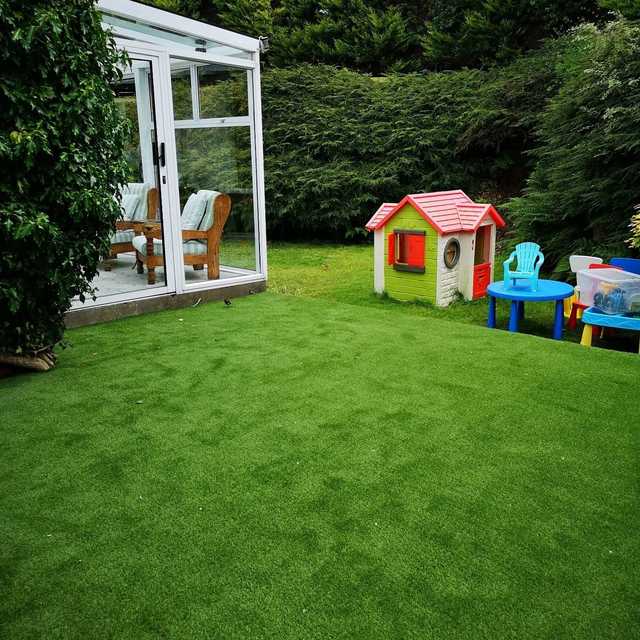
It has real environmental downsides: it's made from plastic, it isn't a habitat and it eventually has to be replaced. The EU microplastics restriction targets loose plastic infill on sports pitches, not garden lawns, which usually have kiln-dried sand or no infill at all. Used where a real lawn struggles, with planted borders kept around it, the impact can be reduced.
Our short answer
Artificial grass isn’t environmentally neutral, and we won’t pretend it is. It’s plastic, nothing lives in it, and sooner or later it has to be replaced. A healthy real lawn with plants around it is better for nature.
Not every garden has a healthy lawn, though. If the real choice is between artificial grass and mud, bare ground or paving, the comparison looks different. You can also do a fair bit to keep a garden good for wildlife with artificial grass in it.
The downsides
It isn’t a habitat
A real lawn supports worms, insects and soil life, and birds feed on them. Leave a lawn to grow a little longer and it will flower with clover and dandelions for the bees. Artificial grass has none of that.
It’s made from plastic
Artificial grass fibres are usually made from plastics such as polyethylene and polypropylene, which come from fossil fuels. At the end of the lawn’s life, the material has to go somewhere. As the grass ages and wears, small bits of fibre can also break off.
It gets warm
In strong direct sun, artificial grass gets noticeably warmer than a real lawn, because living grass gives off moisture that helps keep it cool. In an Irish summer that’s rarely a problem for long.
The EU microplastics restriction
You may have heard that the EU has banned artificial grass. It hasn’t. What it has done is restrict intentionally added microplastics under Commission Regulation (EU) 2023/2055, which came into force in October 2023.
For artificial surfaces, the part that matters is granular infill: the small, loose rubber or plastic granules spread into sports pitches to cushion them. These granules can be carried off pitches on boots and clothing and washed into drains, soil and waterways. Under the regulation, this kind of infill can no longer be placed on the market from 17 October 2031. The long run-in was meant to let existing pitches reach the end of their working life.
What it means for a garden lawn:
- Garden artificial grass isn’t banned. The restriction is aimed at loose plastic granules, not at the grass itself.
- Garden lawns don’t usually use rubber infill. They’re normally laid with no infill at all, or with kiln-dried sand brushed in, which is a natural mineral and not a plastic.
- Sports pitches are where the change will be felt, as they move to other infills or to systems with no infill.
Where artificial grass can make sense
Even with those downsides, there are places where artificial grass is a reasonable choice:
- Instead of paving or concrete. On a permeable stone base, rain soaks through artificial grass into the ground, where a sealed surface would send it running straight off.
- No mowing, feeding or weedkillers. That means no petrol mower, and no lawn feed or moss killer every spring.
- Ground where grass won’t grow anyway, such as deep shade, heavy-traffic areas or dog runs that would otherwise be bare mud.
- Watering. This counts for less here than in drier countries, as Irish lawns don’t often need much watering.
| Healthy real lawn | Artificial grass | Paving or concrete | |
|---|---|---|---|
| Wildlife habitat | Yes | No | No |
| Rain soaks into the ground | Yes | Yes, on a permeable base | Often not |
| Mowing, feed, weedkiller | Often | No | No |
| Plastic content | None | Yes | None |
End of life and recycling
Recycling routes for used artificial grass are still limited, and in practice old grass often has to be disposed of as waste. That makes lifespan the biggest environmental factor you control. A well-made lawn on a proper base, looked after, lasts far longer than a cheap one laid on soil that has to be ripped up after a few years. Our guide to how long artificial grass lasts covers what affects that.
Keeping the garden good for wildlife
Artificial grass works best as one part of a garden, with plenty growing around it. If you’re putting it in, we’d suggest:
- Don’t go wall to wall. Keep beds and borders around the lawn.
- Keep hedges and trees. They give birds food, shelter and places to nest.
- Plant for pollinators. Choose plants that flower across the seasons. The All-Ireland Pollinator Plan has simple, practical advice for gardens.
- Leave a wild corner. A patch of longer grass, a log pile or some bare earth helps insects.
- Add water. Even a small pond or a bird bath makes a difference.
- Avoid pesticides in the rest of the garden.
Our view
After more than 20 years fitting artificial grass, we think it’s the right answer for some gardens, not all of them. If your lawn is thriving and you enjoy it, keep it. If it’s a muddy, shaded or dog-worn patch that never recovers, artificial grass with good planting around it can give you a garden you’ll actually use. Our comparison of artificial grass vs real grass sets out the trade-offs side by side.
If you’d like us to look at whether artificial grass suits your garden, contact us for a free quote and free samples.
Frequently asked questions
Is artificial grass being banned in the EU?
No. Commission Regulation (EU) 2023/2055 restricts intentionally added microplastics, and for artificial surfaces it targets granular plastic infill, mainly the rubber crumb used on sports pitches. Artificial grass itself isn't banned.
Does garden artificial grass use rubber infill?
Not usually. Garden lawns are normally laid with no infill, or with kiln-dried sand brushed in, which is a natural mineral and not a plastic.
Can artificial grass be recycled?
Recycling routes for used artificial grass are still limited, so at the end of its life it often has to be disposed of as waste. The best thing you can do is choose good-quality grass, have it laid properly and look after it so it lasts as long as possible.
Is artificial grass better for the environment than paving?
Neither is a habitat. But artificial grass on a permeable stone base lets rain soak into the ground, while sealed paving or concrete can send it straight to the drains. Either way, planting around the edges does the most for wildlife.