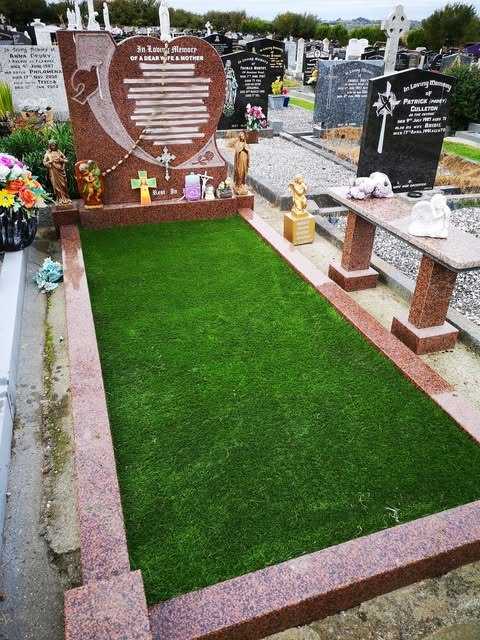
Deep-pile artificial grass fitted inside the kerbs keeps a family grave green and tidy all year, with no weeding. Before anything is fitted, check with whoever runs the cemetery (the local authority, the parish or a committee), because rules differ and some sections don't allow any covering at all.
Keeping a family grave tidy
A family grave takes regular work to keep looking well. Weeds come up through the chippings, and real grass inside the kerbs needs cutting. After a wet Irish winter it can look neglected however often you get to visit.
Families usually come to us for one of a few reasons:
- they live some distance away, or abroad, and can’t visit as often as they’d like
- an older relative has been looking after the grave and it’s getting to be hard work
- they want it neat and green all year, including for anniversaries and cemetery Sunday
- weeds keep coming through the chippings or gravel
For graves we use deep-pile grass, which has longer, fuller fibres than a typical garden lawn. It gives a soft, tidy finish inside the kerbs and keeps its colour through the seasons.
Check the cemetery rules first
We always raise this before anything else, because it decides whether the job can go ahead at all. Burial grounds in Ireland are run by local authorities, parishes or local community groups, and each can have its own rules. Local Government Ireland explains that local authorities can make bye-laws for their burial grounds, covering things like headstones, monuments and conduct.
In practice:
- Lawn cemetery sections usually don’t allow anything on the plot. Wexford County Council’s burial ground bye-laws, for example, say that no stones, pebbles or any other materials are to be used to infill the surface of lawn cemetery plots, which the council keeps grassed. Artificial grass can’t go there.
- Traditional kerbed graves are where artificial grass is normally fitted, inside the kerbs. Even so, rules vary from one burial ground to the next, so check first.
- Parish and community-run cemeteries have their own arrangements. The caretaker, registrar or parish office can tell you what’s allowed.
Make sure the rest of the family, and whoever the grave is registered to, are happy with the plan too, before anything is done.
How artificial grass is fitted on a grave
No two graves are quite the same, but a typical fitting goes like this:
- Clearing the surface. Old chippings, gravel, weeds and dead plants are lifted out from inside the kerbs by hand and bagged up.
- Levelling. The surface is levelled and firmed, and topped up with sand or fine stone where it has sunk.
- Weed membrane. A membrane goes down to stop weeds coming up from below.
- Cutting to shape. The grass is cut to fit tight inside the kerbs and around the headstone base, vases and any plaques.
- Securing. The grass is fixed so it sits tight to the kerbs and won’t lift in the wind.
- Finishing. The fibres are brushed up, all the waste is taken away and the stonework is left clean.
We work quietly, and we’re careful around the stonework and the graves on either side. There’s more on our graves page.
Timing after a recent burial
After a burial the ground needs time to settle, and the kerbs or headstone often have to be reset before anything else is done. Many cemeteries have their own rules on how soon stonework can go back. We’d normally wait until the grave has settled and the stonework is finished before fitting grass, so it doesn’t sink or have to be done twice.
If there’s a further burial in the grave later, the grass will need to be lifted beforehand. Depending on its condition, it can sometimes be refitted, or a new piece fitted once the ground has settled again.
Looking after it
Artificial grass on a grave needs very little care, which is much of the point. When you visit:
- clear away leaves, twigs and old flowers before they rot on the surface
- give it a light brush to lift the fibres
- rinse off any bird droppings or soil with a drop of water
- keep candles and lanterns on the stonework or in a holder, not on the grass, as heat can melt the fibres
For more general advice, see our guide on how to clean artificial grass.
When it may not suit
Artificial grass isn’t for every grave. Leaving aside lawn sections where it isn’t allowed, some families would rather have planting or the look of natural stone chippings, and that’s a perfectly good choice. If the kerbs are cracked or loose, get a stonemason to look at them first. The grass will only look as good as the stonework around it.
| Grave type | Artificial grass? |
|---|---|
| Traditional grave with kerbs | Usually possible, depending on the cemetery’s rules |
| Lawn cemetery plot | Generally not allowed |
| Recent burial | Wait until the ground has settled and the stonework is done |
| Damaged or loose kerbs | Get the stonework repaired first |
If you’d like to talk about covering a family grave, get in touch. We’ll give you a free quote and bring free samples of deep-pile grass, and we can help you find out what your cemetery allows.
Frequently asked questions
Is artificial grass allowed on graves in Ireland?
It depends on the cemetery. Many traditional kerbed graves can have it fitted inside the kerbs, but lawn cemetery sections usually don't allow anything on the plot. Check with the local authority, parish or cemetery committee first.
How soon after a burial can artificial grass be fitted?
The ground needs time to settle after a burial, and the kerbs or headstone may have to be reset first. We'd usually advise waiting until the grave has settled and the stonework is finished.
What happens if there's another burial in the grave?
The grass has to be lifted beforehand. Depending on its condition it can sometimes be refitted, or a new piece fitted once the ground has settled again.
Does artificial grass on a grave need any upkeep?
Very little. Clear away leaves and old flowers, give it a light brush now and then, and rinse off any bird droppings or soil. That keeps it looking well.