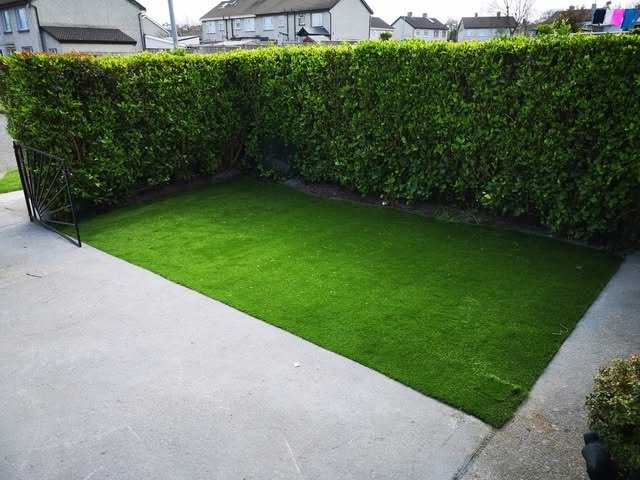
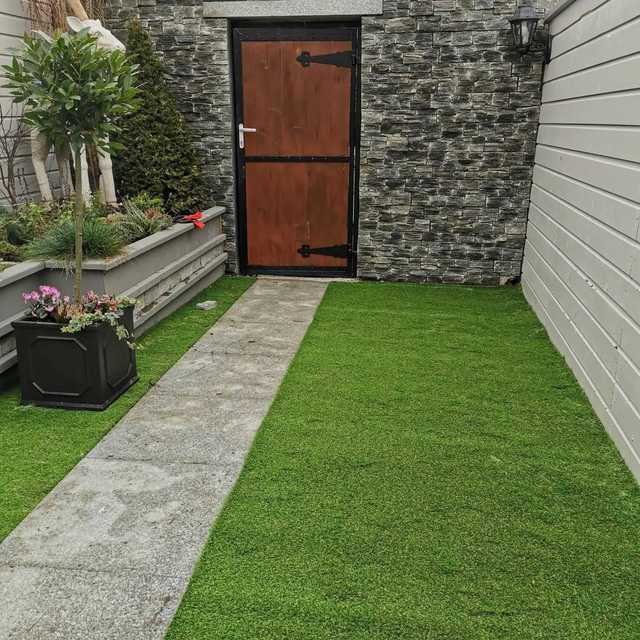
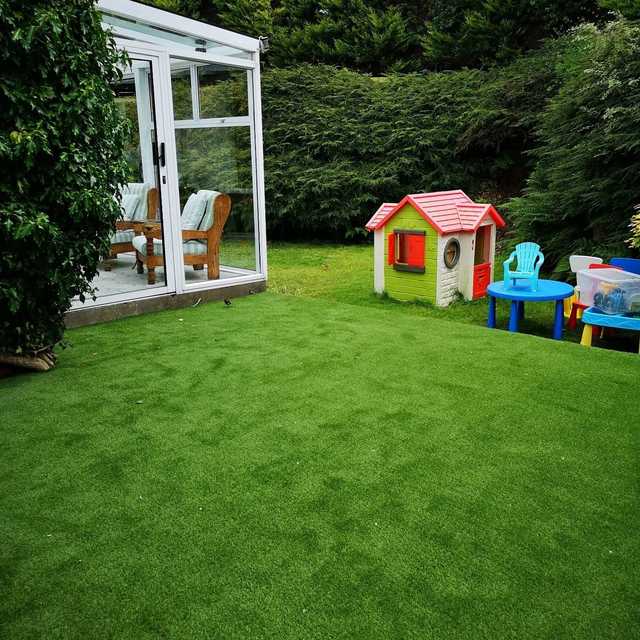
Yes. Artificial grass has a perforated or permeable backing, so rain passes straight through into a compacted stone sub-base below. How well it drains in practice depends on that base and the ground under it, so gardens on heavy clay or low-lying ground sometimes need extra drainage.
Yes, if the base is right
Artificial grass drains, and in a climate as wet as ours that’s one of the main reasons people go for it. A lawn that’s soft and muddy from October to April becomes something you can walk on all year.
The grass is only the top layer, though. Whether your lawn copes after a week of rain in the south-east depends almost entirely on what’s under it. In more than 20 years fitting artificial grass, we’ve found that puddles nearly always come down to the groundwork, not the grass.
How water gets through artificial grass
Artificial grass has either a perforated backing, with small drainage holes across the whole roll, or a fully permeable backing that water soaks through. Rain runs down through the fibres, passes through the backing and then:
- drains through a thin levelling layer of granite dust or sharp sand
- into a compacted crushed stone sub-base, such as Clause 804, with plenty of space between the stones for water
- and from there into the ground below, or to a drain or soakaway where one has been fitted.
The stone sub-base does two jobs. It gives the lawn a firm, even foundation that won’t sink, and during heavy rain it holds the water while the ground underneath catches up.
Why puddles happen
When we’re called out to a lawn that holds water, it’s usually one or more of these:
- No proper sub-base. Grass laid on soil, old turf or a skim of sand sinks unevenly and holds water in the dips.
- Uneven levelling. Small hollows in the levelling layer show up as puddles after every shower.
- Too much sand. A thick layer of sand under the grass can hold water and shift over time.
- Compacted clay underneath. If the dug-out area sits on dense clay, the sub-base can fill up like a bath with nowhere for the water to go.
- Water coming in from elsewhere. Run-off from a patio, a neighbouring garden or a downpipe emptying onto the lawn can swamp any base.
- A clogged surface. Leaves, soil and moss left to build up slow the water getting through the backing.
Heavy clay
Soil varies a lot across Wexford and the wider south-east. Coastal gardens on sandy, free-draining ground are usually straightforward. Inland, plenty of gardens sit on heavy clay that stays wet long after the rain stops, and that’s where the job needs more thought.
On clay, we may:
- dig out to the deeper end of the usual 75–100 mm, or further where the ground is very soft
- go over the sub-base thoroughly with the whacker plate so it doesn’t settle into the clay
- build in a gentle fall, so water moves towards a lower edge instead of sitting in the middle
- add a drainage channel or perforated pipe to carry water to a suitable outlet, such as a soakaway, where that’s practical
We’d much rather spend the time on this before the grass goes down than come back to a puddle afterwards.
What usually helps, by type of ground
| Ground | What usually helps |
|---|---|
| Sandy or free-draining soil | A standard compacted stone sub-base is normally enough |
| Heavy clay | A well-compacted, sometimes deeper sub-base with a fall, plus a drain or soakaway if the water can’t get away |
| Low spots that collect run-off | Deal with where the water is coming from first, then a channel or pipe to a suitable outlet |
| Concrete or paving | Relies on the surface having a fall, with drainage holes where needed |
If you’re thinking of laying grass on an existing slab, our guide to artificial grass on concrete or decking covers drainage on hard surfaces in more detail.
Fixing a lawn that puddles
Often it can be fixed. If it’s a few small dips, the grass can sometimes be folded back at a join, the levelling layer topped up and re-compacted, and the grass put back down. If water is coming in from a downpipe or patio, redirecting it can sort the problem on its own.
If the lawn was laid with no stone sub-base at all, there’s no shortcut. The grass has to come up, the ground has to be dug out and a proper base built. If the original grass is in good condition, it can sometimes be relaid.
Keeping it draining well
- Clear leaves and debris regularly, especially in autumn.
- Brush the grass every few weeks so soil and grit don’t settle into the backing.
- Send downpipes and patio run-off to a drain, not onto the lawn.
- If a puddle appears where there wasn’t one before, get it looked at early.
You can read more about how we prepare the ground on our how we install page, and see finished gardens on our projects page.
If you’re worried about drainage in your garden, or you have an artificial lawn that’s holding water, contact us for a free quote and free samples. We’ll look at the ground and tell you straight what it needs.
Frequently asked questions
Why is there a puddle on my artificial grass?
Usually the base is uneven or too thin, or it's sitting on compacted clay with nowhere for the water to go. Small dips can sometimes be lifted and relevelled, but a lawn laid without a proper stone sub-base generally has to be redone.
Can artificial grass be laid on clay soil?
Yes, but clay needs more thought. The sub-base has to be well compacted, and where water can't get away we may add a fall, a drainage channel or a pipe to a suitable outlet such as a soakaway.
Does artificial grass drain better than real grass?
On a well-built base it usually clears surface water faster than a real lawn on the same soil, because the water goes straight into free-draining stone. It can't make waterlogged ground go away, though, so what's underneath still matters.
Is artificial grass damaged by frost or snow?
No. Frost and snow don't harm it, water drains as normal once it thaws, and you can use the lawn all winter without it turning to mud.